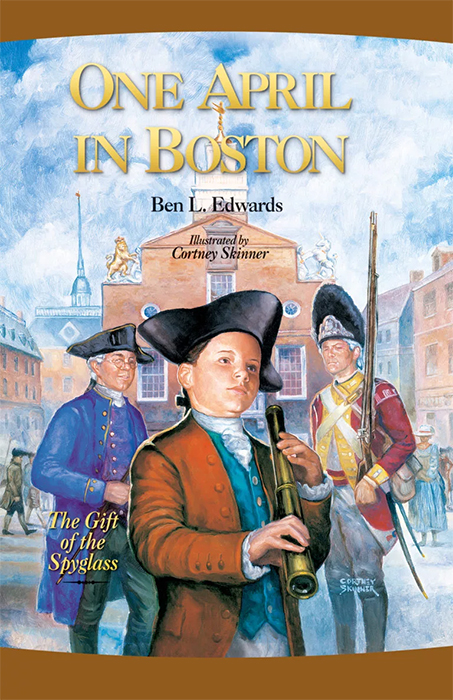
Step Back in Time

Cobblestone Streets

Boston Map 1775 (PDF)

Boston History Timeline

This Interactive Timeline outlines key moments in the history of Boston and the Edwards family.

1630
September 17 - The town of Boston is founded by John Winthrop and the Puritans.

1635
April 3 - Boston Latin School, the first public school in the colonies, is established.

1675
June 8 - King Philip's War begins.

1689
The first of four French and Indian Wars breaks out.

1706
January 17 - Benjamin Franklin, the youngest son of Josiah and Abiah (Folger) Franklin is born on Milk Street.
December 10 - Captain Benjamin Edwards (1685-1751), age 20, is married to Hanah Harrod by Doctor Cotton Mather at the Second Church.

1713
The Townhouse (today's Old State House) is built of brick, after the original wooden structure was destroyed by a fire in 1711.
April 12 - Captain Edwards, aboard the ship Sarah, sails for London.

1714
March 28 - Captain Edwards, aboard the ship Sarah, sails for Leghorn, Italy. His signature from this time period still exists today.

1718
At the age of 12, Benjamin Franklin is apprenticed to his older brother James who recently returned from England with a printing press and a few fonts of type to set up business in Boston.
The growing town of Boston has a population of about 12,500.

1719
November 14 - Captain Benjamin Edwards attends a meeting at the home of shipwright Alexander Sears and along with 23 others agrees to purchase land and establish the New Brick Church.

1721
May 10 - The New Brick Church is dedicated in the North End. Its distinctive rooster weather vane will become a prominent feature of the Boston skyline.
James Franklin starts publishing the New England Courant, one of the first newspapers in America.
Smallpox epidemic in Boston.

1722
January 10 - Captain Edwards is aboard the ship Greyhound, just one day off the coast of Honduras in the Caribbean, when his vessel is attacked by the ruthless pirate George Lowther. Edwards and his crew of 14 men battle Lowther's ship the Happy Delivery with 90 pirates aboard for an hour. When he finally surrenders, the pirates board Edwards' ship, capture the crew and set the Greyhound on fire. Captain Edwards is eventually released and allowed to make his way back to Boston.
April 2 - Using the pen name Silence Dogood, Benjamin Franklin has the first of 14 letters he writes without his brother's knowledge appear in the New England Courant.

1723
Christ Church (known today as the Old North Church) is built. Its steeple will not be added until 1740.
September - Benjamin Franklin at age 17, runs away from his apprenticeship, goes to New York and then to Philadelphia where he is employed as a printer.

1728
September 24 - Captain Edwards' wife Hanah dies.

1730
May 14 - Captain Edwards, age 44, is married to 29-year-old Bathsheba Evans by the Reverend William Welstead at the New Brick Church.
Boston contains 1,700 dwellings and has a population of 15,000.

1733
December 18 - Alexander Edwards (1733-1798), son of Captain Benjamin and Bathsheba (Evans) Edwards, is born at the family home in the North End. He will become a cabinetmaker.

1734
December 22 - Paul Revere (1734-1818) the future silversmith and midnight rider is baptized at the New Brick Church.

1737
May 9 - Dolling Edwards (1737-1773), son of Captain Benjamin and Bathsheba (Evans) Edwards, is born at the family home in the North End.

1742
Faneuil Hall is built. The two-story brick building containing a ground level market with a meeting hall above is gifted to the town by wealthy merchant Peter Faneuil. The size of the structure is forty by one hundred feet (half its present width) and it can hold 1,000 people. A grasshopper weather vane is placed atop the building.

1745
March 26 - Captain Benjamin Edwards is sworn in as one of six tax collectors in Boston.
Each year he and other town officials attend the annual walk (or visitation) of the town. Afterward, they gather for a meeting at Faneuil Hall.

1749
March 7 - Captain Edwards pays a visit to Thomas Hancock at his mansion house on Beacon Hill and collects "five hundred pounds old tenor in parts of his tax."
Living with Thomas Hancock and his wife Lydia at the time is his 12-year-old adopted nephew John Hancock.

1751
August 26 - Captain Edwards dies and is buried at Copp's Hill. Some of his personal property will soon be sold at public auction to raise funds for his six children.
December 25 - Dolling Edwards, age 14, accepts Nathaniel Greenwood as his guardian. Dolling will become a mastmaker at Captain Greenwood's Mast-yard, part of the Greenwood family shipyard in the North End.
The population of Boston reaches 17,500.

1760
October 25 - George III becomes king of England.

1763
February 10 - A treaty between England and France ends the French and Indian War.

1765
March 22 - British Parliament passes the Stamp Act in an effort to recoup the costs of protecting the colonists during the French and Indian War. According to the Act, paper products, dice and playing cards will have a tax stamp affixed and the tax must be paid for by the user. The colonists are furious.
April 14 - Benjamin Edwards (1765-1808), son of Dolling and Rebecca (Christie) Edwards, is baptized at the New North Church. He will become a cooper.
August 14 - First public protest of the Stamp Act occurs. Members of the newly formed Sons of Liberty hang an effigy of the Stamp Master from a majestic elm tree that stands near Boston Common. The elm will become Boston's Liberty Tree.
The population of Boston drops below 16,000 and it contains 1,676 homes.

1766
March 18 - Parliament repeals the Stamp Act.
May 19 - The repeal of the Stamp Act is celebrated in Boston.
Parliament passes the Declaratory Act asserting its right to make laws binding in the colonies "in all cases whatsoever."

1767
June 29 - Parliament passes the Townshend Acts placing duties on glass, paint, paper and tea.
The colonies begin to boycott British goods.

1768
September 30 - The British fleet sails into Boston Harbor. Two Regiments of Regulars land at Long Wharf and, shouldering loaded muskets, they march into town on October 1. They are commanded by General Thomas Gage. The citizens of Boston resent their presence.

1769
July 31 - Cabinetmaker Alexander Edwards and 100 other inhabitants of the town formalize their commitment to boycott British goods by signing the Boston Citizen's Non-Importation Agreement.
August 14 - Alexander Edwards and other members of the Sons of Liberty gather at Liberty Tree in Boston and drink 14 toasts to celebrate the 4th anniversary of their first Stamp Act protest. They then ride on horseback to Robinson's Tavern in Dorchester where about 300 members dine at a banquet that is later described in great detail in the diary of John Adams.

1770
March 5 - The Boston Massacre takes place. A group of British soldiers fires into a crowd of colonists who are taunting them outside the Custom House and five colonists are killed. Silversmith Paul Revere soon makes an engraving of the event to support the patriot cause.
April 12 - Repeal of the Townshend Acts, except for the duties on tea.

1773
April 4 - A fire breaks out at the cabinetmaking shop of Alexander Edwards on Back Street in the North End. It destroys his work shop, and many other buildings. Alexander Edwards' loss is great but his shop is rebuilt and opens again in late August.
May 10 - Parliament passes the Tea Act in an effort to save the East India Company from bankruptcy.
Dolling Edwards dies and is buried at Copp's Hill.
December 16 - The Boston Tea Party takes place. After a gathering at Old South Meeting House, members of the Sons of Liberty disguised as Mohawk Indians march to Griffin's Wharf, board three British ships, and throw 342 chests of tea into Boston Harbor.

1774
March 31 - Parliament passes the first of the Intolerable Acts also known as the Coercive Acts. These include the Boston Port Bill which closes the port of Boston on June 1 to all but the King's warships until payment is made for the tea that had been destroyed.
General Thomas Gage becomes Royal Governor of Massachusetts.
June 2 - Parliament amends the Quartering Acts of 1765 and 1766. Previously the colonists were required to provide soldiers with living accommodations in public facilities like inns, taverns or unoccupied buildings. The revised law now authorizes the use of occupied facilities, including private homes.

1775
April 18 - A few blocks away from the Edwards home, sexton Robert Newman displays two lanterns from the northwest window of Christ Church steeple (today's Old North) as Paul Revere is being rowed across the Charles River to begin his Midnight Ride. Revere and William Dawes alert the countryside of the Regulars' march to Lexington and Concord.
April 19 - Battles occur on Lexington Green and at Concord Bridge. Colonists fight the British Regulars as they make their way back to Boston. The American Revolution has begun.
June 17 - The Battle of Bunker Hill takes place at nearby Breed's Hill in Charlestown. There are many casualties on both sides including patriot leader Doctor Joseph Warren.
The population of Boston falls to 6,573 in July before last permission to leave is given. British troops, their women and children number 13,600.

1776
March 17 - General Washington has placed his cannon on Dorchester Heights overlooking Boston Harbor and the British are forced to evacuate the town.
July 18 - A copy of the Declaration of Independence, carried by messenger rider from Philadelphia, is read to the citizens of Boston from the balcony of the Town House, which is soon renamed the State House.

1781
October 26 - Word of Cornwallis's surrender at Yorktown, Virginia to Generals Washington and Rochambeau reaches Boston.

1782
July 25 - Sally Edwards (1761-1808), daughter of Dolling and Rebecca (Christie) Edwards, marries silversmith Paul Revere Jr. (1760-1813). They had had three children by the time this advertisement for the Revere family business appeared in a Boston newspaper.

1783
September 3 - The Treaty of Paris officially ends the American Revolution and independence is achieved.
The population of Boston is about 12,000.

1789
October 24 - George Washington, recently elected first President of the United States, visits Boston on his tour of the eastern states.

1791
June 22 - Cooper Benjamin Edwards (1765-1808) is married to Polly Bangs by Reverend John Clarke at the First Church of Boston located behind the State House.
The census of 1791 states that the population of Boston is a little over 18,000 with 2,376 homes.

1795
July 4 - The cornerstone for the New State House on Beacon Hill is laid in a ceremony overseen by Governor Samuel Adams, and Grand Master of the Masons, Paul Revere.

Home | Walking Tour Information | Book a Walking Tour | Free Audio Book | Contact Us | Links | Site Map

Copyright © 2004-2008 Walking Tours of Historic Boston. All Rights Reserved. Email the webmaster.